Musician Invoice Template
A gig invoice is really a record of the booking. The fee is the easy part. What causes the arguments afterwards is everything around it: how long the sound check ran, whether the second set was in the quote, who paid for the van, and what happens when the couple asks for one more song at half past midnight. Put those on the invoice as their own lines and the conversation at load out is about nothing more interesting than which account to pay.
This free musician invoice template starts you with a live performance fee, an equipment line and travel, plus deposit terms already written into the payment field. Change the set structure, put your own fee in, add your logo, and download a clean PDF straight from your browser. Your invoice is not uploaded, no account is needed, and there is no watermark on the result.
Open this template in the free generator →
No signup. No watermark. Runs in your browser.
Download as Word (.docx) Excel (.xlsx) PDF in the generator
What this template starts you with
| Description | Qty | Rate |
|---|---|---|
| Live performance (3 hours) | 1 | 750.00 |
| Equipment and setup | 1 | 150.00 |
| Travel | 1 | 80.00 |
What a good musician invoice includes
- Performance, equipment hire and travel as separate lines, so nothing looks like padding on the fee
- The set structure spelled out: how many sets, how long each one runs, and what the break is
- Sound check time on the invoice, at zero if it is included, so the client sees it was not free by accident
- A deposit line showing what was already paid and when, with the balance as the total
- An agreed overtime rate in the notes, priced per started block rather than per hour
- Who the invoice is actually for: the venue, the agency or the private client paying on the night
What to put on a musician invoice
| Field | Example | Why it matters |
|---|---|---|
| Your name or band name and address | The Kestrel Trio, 8 Ferry Road, Bristol | Venues and agencies cannot set you up as a supplier without a full postal address, and private clients want to know who they are paying. |
| Who is paying | Ashgrove Manor Events Ltd, not the bride's mother | Weddings and corporate parties often have three people involved. Name the one who signed the booking, because that is the one accounts will pay. |
| Invoice number | 2026-037 | Unique and sequential. Your bookkeeping needs it and an agency's finance system will refuse the invoice without one. |
| Event date and venue | Saturday 6 June 2026, Ashgrove Manor | This is what the client recognises. An invoice that names the event gets approved without anyone having to look anything up. |
| Issue date and due date | Issued 20 May, balance due 6 June | For private bookings the balance is normally due on the day. For agencies, a calendar date beats "net 30" every time. |
| Set structure as its own line | Two 60 minute sets with a 30 minute break | The single most common dispute in live music is what the fee covered. One line removes it. |
| Sound check and get in time | Sound check and line check on site, included | List it even at zero. It is two hours of your day, and showing it at zero is how you get paid for it next time. |
| Equipment hire | PA system and stage lighting hire | If you are supplying the system rather than playing through the venue's, that is a hire charge, not part of your fee. |
| Travel | 140 miles return at your mileage rate | Shown as quantity times rate so the client can check it. A flat "travel" number invites a haggle. |
| Accommodation where it was agreed | Overnight accommodation, agreed in the booking | Only ever appears if it was agreed in writing beforehand. On the invoice it is a reminder, not a request. |
| Extra preparation | Learning and arranging a requested first dance song | Special requests are work done before the event. Price them at the booking stage and they are uncontroversial on the invoice. |
| Overtime actually played | One started 30 minute block after midnight | Bill it in the blocks you agreed, not in fractions of an hour. Nobody argues with a rule they already accepted. |
| Deposit already paid | Less deposit paid 14 March | A negative line, so the total is the balance. Clients pay balances quickly and query new totals slowly. |
| Payment details and a reference | Bank details plus the event date as the payment reference | On a Saturday night, three payments can land in your account within an hour. The reference is what tells them apart. |
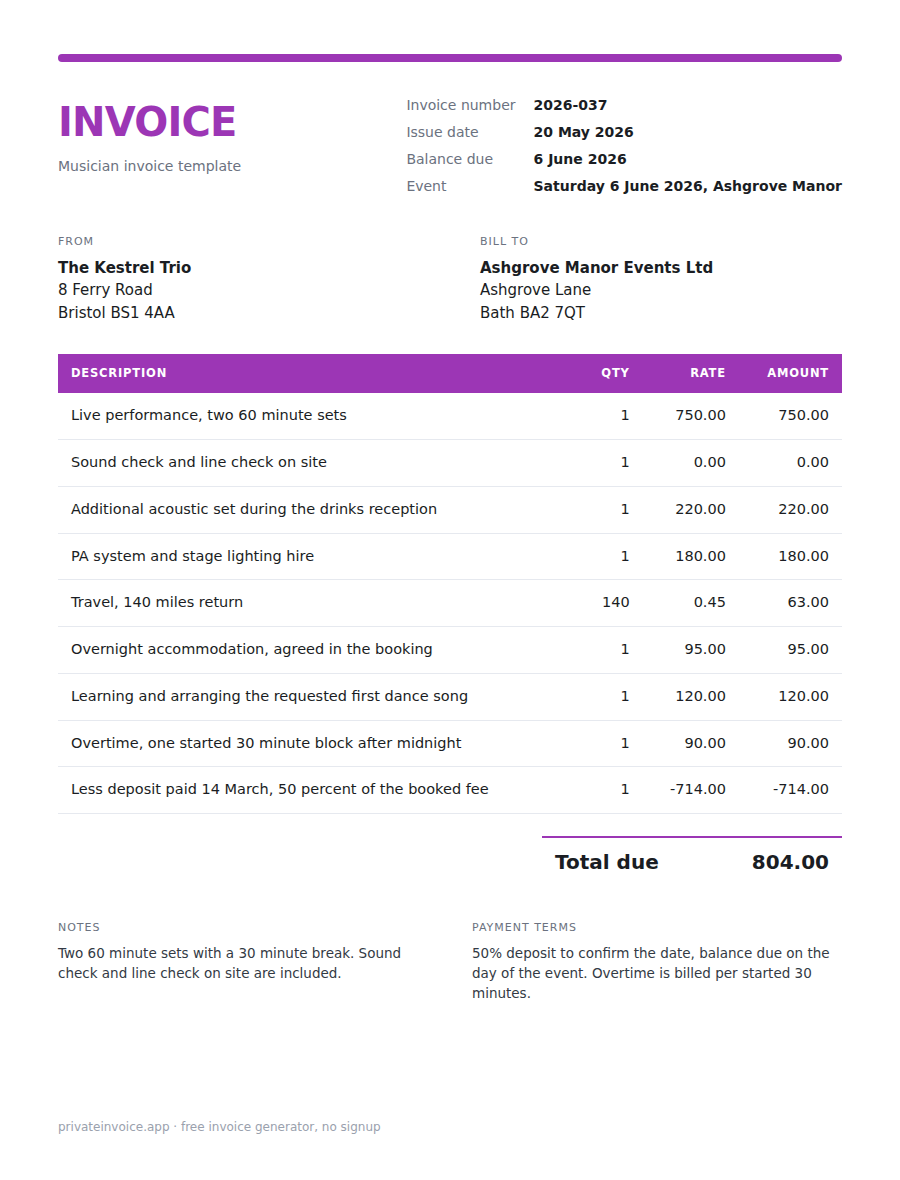
A wedding reception booking, line by line
Here is what a realistic wedding invoice looks like when the booking is broken out properly, including the bits that are usually given away. Amounts are placeholders in whatever currency you set in the generator.
| Line item | Qty | Rate | Amount |
|---|---|---|---|
| Live performance, two 60 minute sets | 1 | 750 | 750 |
| Sound check and line check on site | 1 | 0 | 0 |
| Additional acoustic set during the drinks reception | 1 | 220 | 220 |
| PA system and stage lighting hire | 1 | 180 | 180 |
| Travel, 140 miles return | 140 | 0.45 | 63 |
| Overnight accommodation, agreed in the booking | 1 | 95 | 95 |
| Learning and arranging the requested first dance song | 1 | 120 | 120 |
| Overtime, one started 30 minute block after midnight | 1 | 90 | 90 |
| Less deposit paid 14 March, 50 percent of the booked fee | 1 | -714 | -714 |
| Total | 804 |
The arithmetic is worth following, because clients do follow it. The booked fee came to 1,428: performance, extra set, PA hire, travel, accommodation and the first dance arrangement. The deposit was half of that, 714, paid in March when the date was confirmed. On the night the band played one block past the agreed finish, which added 90. That leaves a balance of 804, and the invoice says so rather than making anyone work it out.
The zero priced sound check line is deliberate. It is two hours of your day that the client never sees on a quote, and putting it on the invoice at zero makes it visible without charging for it. The next time the same venue books you and asks for an early get in, you have a line item to point at.
Overtime appears as a block, not as minutes. If your terms say overtime is billed per started 30 minutes, then eleven minutes past the finish is one block, and the invoice reflects the rule the client already agreed to. That is a much shorter conversation than an hourly rate divided into fractions at one in the morning.
Payment terms that work for gigs
Take a deposit to hold the date. Half is the usual figure for private events, and it is not about distrust: it is what stops a Saturday in June being blocked out for eight months and then released three weeks before, when nobody else is looking. Say on the booking form and on the invoice that the deposit confirms the date and that the date is not held until it clears.
For private clients, make the balance due on the day of the event. Weddings and parties are one off transactions with people who have no accounts department and no reason to think about you again on Monday. Getting paid before the van is loaded is normal in this trade, and everyone in the room expects it.
Agencies, venues and corporate bookers are the opposite case. They have a purchase order system and they pay on terms, usually somewhere between 14 and 30 days. Accept that, but ask for the purchase order number before the event and put it on the invoice, because an invoice without one can sit in a queue for a month before anyone tells you why.
Write the cancellation terms down and keep them proportionate. A common structure is that the deposit is non refundable once the date is held, and that a cancellation inside a set window, often 30 days, leaves the full fee payable. You will almost never enforce the second half. Having it written down is what makes a rescheduling conversation reasonable instead of a negotiation from nothing.
Agree the overtime rate before the event, quote it per started block, and put it in the notes field so it prints on the invoice the client is holding. Surprise charges added after the last song are the fastest way to lose the referral that the gig was actually worth.
Setting your fee
We do not publish fee benchmarks here. The numbers that circulate in musicians' forums come with no region, no line up and no idea what was included, and copying one is how people end up doing a four hour wedding for a figure that does not cover the van. Build the number from your own side instead.
Start with the whole day, not the stage time. A two hour wedding set is typically a ten hour day once you count load in, travel, sound check, waiting, the performance itself and the load out at midnight. Divide the fee you are quoting by that number of hours and see whether you would take the same money to do anything else with a Saturday.
Then add what the fee is buying beyond your time: rehearsal for a set you are not currently playing, a song learned specially, the cost of the PA if you own it, fuel, and the Sunday you lose recovering. A band splits the fee several ways, so work out the per player figure before you quote, not after the client has said yes.
Price the categories differently. Weddings carry more preparation, more liaison and more risk than a pub function, and they are priced accordingly across the whole trade. Corporate events carry longer waiting times and stricter timings. Keep a separate number for each category rather than one rate you apply everywhere and quietly resent half the time.
Finally, keep the extras as extras. PA hire, lighting, an extra set, a specially arranged song and travel beyond a set radius belong on their own lines at their own prices. Rolling them into one fee makes you look expensive and makes it impossible to discount anything without discounting your playing.
Common questions
How much deposit should I ask for as a musician?
Half the fee to confirm the date is the common structure for private events, with the balance due on the day. Agencies and corporate clients usually prefer to be invoiced in full on net terms instead, which is fine as long as you have the purchase order number before the event.
Should the invoice include the sound check?
Yes, as its own line, even if you are not charging for it. It makes the time visible, it stops the get in quietly stretching from one hour to three, and it gives you something to point at when the same venue books you again and wants you there earlier.
How do I bill overtime at an event?
Agree a rate per started block, usually 30 minutes, before the event, and write it in the notes so it prints on the invoice. On the night, count the blocks and put them on as their own line. The rule does the arguing for you.
What should I do about travel and accommodation?
Show travel as distance times your mileage rate rather than one flat number, so the client can check it. Only invoice accommodation when it was agreed in writing at booking, and show it at cost. Both belong on separate lines from the performance fee.
Do I need an invoice if the client pays cash on the night?
Yes. Cash is still income, your bookkeeping still needs a record of it, and the client often needs the document for their own accounts. Mark the invoice as paid on the day and keep your copy. This template exports a PDF you can send from your phone before you leave the venue.
How should a band split the fee on one invoice?
Invoice the client once, from whoever took the booking, for the whole fee. Splitting a single booking across four separate invoices confuses the client and doubles your paperwork. Handle the split between players afterwards, and keep your own record of what each person was paid.